Suitcases are packed, ESTAs are approved and a petition to legalise haggis in the United States is gathering momentum.
There's only one thing left for the Tartan Army to organise before making the hop across the pond - their preferred starting XI for the opening match against Haiti on June 14.
Five-and-a-half-million backseat drivers are preparing to offer Scotland boss Steve Clarke unsolicited advice on how to set his team up and will be willing to passionately defend their own foolproof winning formulas should any colleague, family member, friend or national team head coach dare to suggest an offensive alternative.
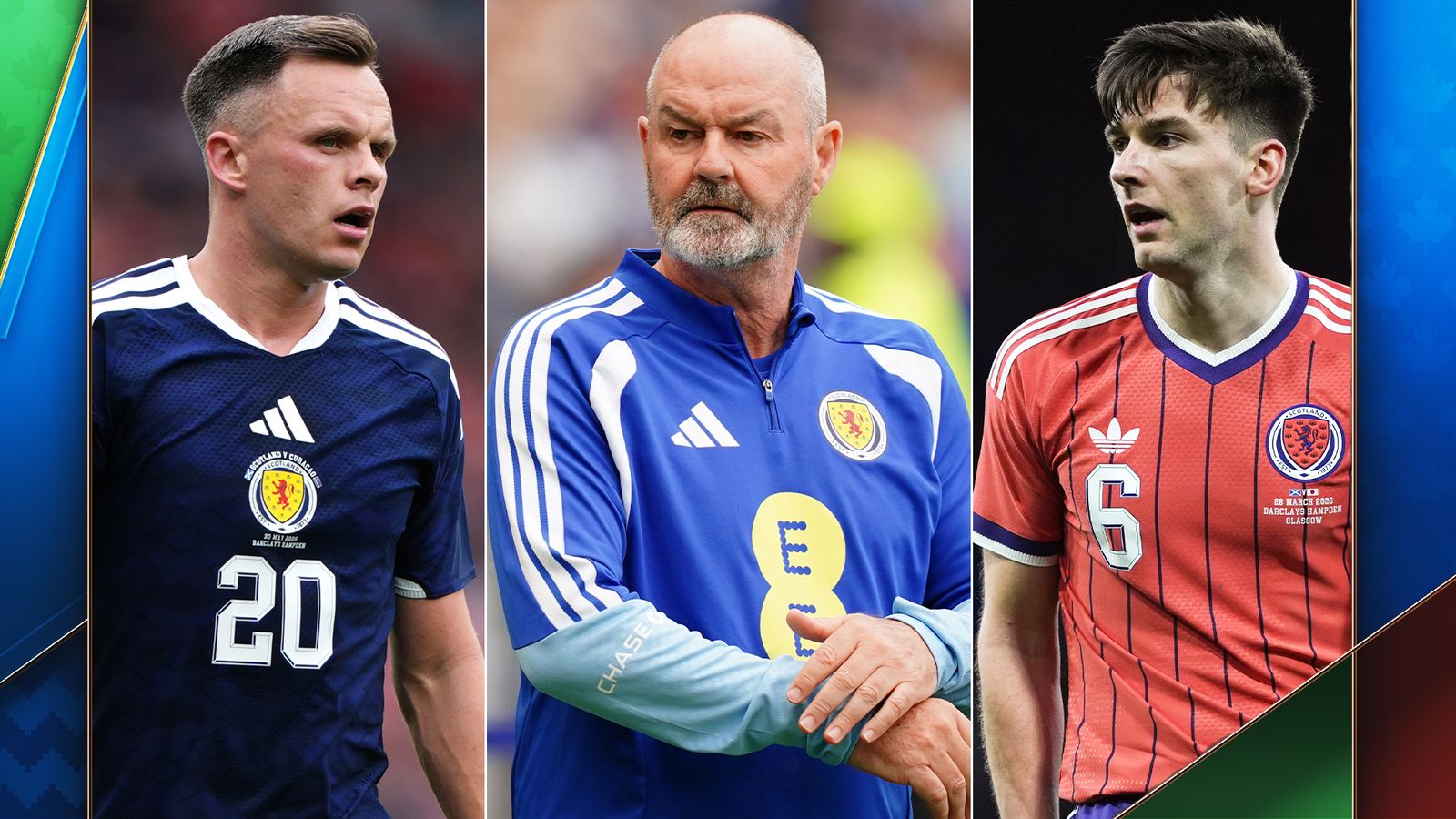
Following Billy Gilmour's tournament-ending knee injury sustained in Scotland's final send-off match against Curacao, there are probably only five individuals in which the country would unanimously agree are nailed-on starters for the group opener: Andy Robertson (Liverpool), Aaron Hickey (Brentford), John McGinn (Aston Villa), Scott McTominay (Napoli) and Ben Gannon-Doak (Bournemouth).
McTominay, Robertson and McGinn started all six games in qualifying; Gannon-Doak started the final five after coming on as a substitute in the opening match away to Denmark; and Hickey was only left out of the starting XI for the two matches against bottom seeds Belarus to manage his minutes as he battled injury.
As Clarke prepares to pick Scotland's first World Cup team in 28 years, here are the five selection questions facing the Scotland boss.
Clarke ditched his beloved back five immediately after Scotland's anticlimactic Euro 2024 exit and hasn't looked back since.
4-2-3-1 became the go-to shape as his side avoided automatic relegation from Nations League A before topping their World Cup qualifying group for the first time in 44 years.
So surely he'll stick with the back four? Probably, but maybe not.
Perhaps Clarke's chosen formation could be dictated by personnel and not preference. That's because, once again, we find ourselves facing the decade-long Robertson-Tierney dilemma at left back.
For years Scotland searched for a solution to allow two of their best players to coexist before Clarke found a way for them to complement one another at left centre-back and left wing-back as part of a 5-3-2, and latterly, 5-4-1.
However, when Kieran Tierney faced an extended period on the sidelines due to a hamstring injury sustained at Euro 2024, Scotland lacked the bandwidth to continue with the back five without its key component.
Now that Tierney is back fit and firing following a title-winning season at Celtic - in which he scored six goals and contributed 12 assists - the Scotland boss may be tempted to find a starting berth for the man who scored the decisive third goal against Denmark in November.
He racked up 53 club appearances this campaign, 17 more than captain Robertson in his farewell season at Liverpool.
Scotland's goalkeeping trio of Angus Gunn (Nottingham Forest), Craig Gordon (Hearts) and Liam Kelly (Rangers) have made a puny tally of seven senior club appearances between them this season.
It's fair to assume Kelly is Clarke's third choice. He's earned just two caps for his country, both in friendlies where the minutes were shared with other back-up options, so it's essentially a toss-up between Gordon and Gunn.
Gordon is 43 years of age and made his national team debut before team-mates Gannon-Doak, Findlay Curtis and Tyler Fletcher were even born.
He's been out with a shoulder injury since February and has only played three times for Hearts this season, but if there was ever a man for the big occasion, it's him.
Despite not having played a minute of competitive football in six months, Gordon was a calming presence between the sticks for Scotland's final two decisive group games in qualifying and even pulled off a match-winning wonder-save for Hearts against Dundee in January when deputising for Alexander Schwolow.
Two years on from missing out on Euro 2024 and playing what was supposed to be his farewell game against Finland at Hampden, Gordon could become the second-oldest player to play at a World Cup finals.
However, Gunn was Clarke's No 1 at the last major tournament two years ago in Germany, and in qualifying before injury.
He's racked up 21 caps in three years since switching allegiance from England but has only managed one substitute appearance for Nottingham Forest this campaign.
Whoever ends up playing is going to be rusty…
Lawrence Shankland (Rangers), Che Adams (Torino), Lyndon Dykes (Charlton), George Hirst (Ipswich) and Ross Stewart (Southampton) - those are the five men vying to lead the line for Scotland at the World Cup.
If we assume Clarke sticks with the 4-2-3-1 formation used in qualifying, that leaves just one starting berth available.
Shankland, who has signed for Rangers, has been showing the best form of the lot. He notched a brace against Curacao and netted 20 club goals in all competitions this term as Hearts fell agonisingly short of a historic first Scottish top-flight title in 66 years.
However, Shankland has never been a favourite of Clarke's - his sole competitive start in a Scotland jersey came against San Marino seven years ago. Even after being named Player of the Year by PFA Scotland and the Scottish Football Writers' Association in 2024, Shankland managed just 21 minutes of gametime at the Euros.
His manager rewards loyalty and rightly so; it's worked well for him in his seven years in charge.
Adams and Dykes have amassed almost a century of caps between them, scoring 21 goals in the process.
It's hardly a remarkable return, but both have been so important to Scotland's success for their work out of possession, and in the build-up, whether that be through Adams' hold-up play or Dykes' aerial qualities.
However, they have the poorest goal return of the five options. Adams scored seven times for Torino this season while Dykes managed five for Birmingham and Charlton in the English Championship.
In the same division, Ipswich's Hirst and Southampton's Stewart each got 11 goals but are far less experienced at international level, with eight and two caps respectively.
Scotland are blessed with a plethora of talent in the middle of the park but Clarke has struggled to find a consistent pair of pivots, holding midfielders, sixes, sitters, or whatever you want to call them.
I can hear you shouting Scott McTominay and John McGinn, arguably Scotland's two best players, but they both primarily play more advanced roles for club and country.
Napoli's McTominay is normally used as a No 10 and has only started in a deeper midfield role once in the last 20 international matches.
Aston Villa captain McGinn is usually deployed off the left for Scotland - his last start in central midfield was almost two years ago in a friendly against Gibraltar.
That leaves a fight between Lewis Ferguson (Bologna), Ryan Christie (Bournemouth), Kenny McLean (Norwich) and Tyler Fletcher (Manchester United) for those two deep midfield spots.
Balance here is the key for Clarke; he's selected two right-footed players (Fletcher and Ferguson) and two left-footed players (Christie and McLean).
I won't get too technical but this is no coincidence.
Ferguson and Fletcher are likely fighting for one jersey while Christie and McLean are fighting for the other.
The evidence certainly points to that anyway. In the last 22 international matches, Clarke has only gone with two midfielders that use the same foot four times, and two of those games were friendlies.
There are some decipherable trends which may be able to help us hypothesise as to which players he uses and when.
With Gilmour ruled out through injury, that could open the door for Ferguson to start against Haiti, a fixture which stylistically would be more suited to the Bologna midfielder.
That's assuming Clarke hands 19-year-old Fletcher his first international start in the opening game of a World Cup.
On the other side, Christie appeared to be the preferred candidate to McLean for the big games in qualifying against Greece and Denmark.
Since any variation of a back-five formation would likely include Tierney at left centre-back, there are two spots up for grabs in the heart of defence, irrespective of shape.
Clarke has picked five experienced natural centre-backs to take to the USA: Grant Hanley (Hibernian), Scott McKenna (Dinamo Zagreb), Jack Hendry (Al Ettifaq), John Souttar (Rangers) and Dominic Hyam (Wrexham).
But none of them are guaranteed starters; Scotland have changed their centre-back pairing in each of their past 10 games.
McKenna, at 29, is the youngest of that quintet and has just eclipsed the 50-cap milestone that has seen him inducted into the International Roll of Honour.
Only 13 people have played more times for Scotland than the ever-present Hanley, who has battled through fitness issues to nail down a starting spot at Hibernian in his first season in Scotland.
Hendry almost played every minute for Al Ettifaq in the Saudi Pro League this year and Souttar was a regular for Rangers - even wearing the armband in captain James Tavernier's absence - before losing his place in the side to Nasser Djiga for the final two months.
Hyam was perhaps a surprise inclusion in the squad given his lack of caps (one at the time of his call-up), but he made 44 appearances in the English Championship this season for both Blackburn and Wrexham as he skippered the Welsh outfit to the brink of the play-offs.
Similarly to the midfield conundrum, it appears Clarke does not yet know who his best back two are.